WELCOME TO THIS PAGE INTENDED FOR STUDENTS AT THE UNIVERSITY OF THE WESTERN CAPE REGISTERED IN 2009 FOR THE MODULE:
QSF 132
| SECOND | SEMES | TER | 2009 | ||
| Period | Monday | Tuesday | Wednesday | Thursday | Friday |
| 1 | qsf g1 t1 (MS10) | qsf g4 t2 (MS7) | |||
| qsf g2 t1 (MS5) | qsf g3 t2 (GH3.1) | ||||
| 2 | qsf g4 (GH3.9) | ||||
| 3 | |||||
| 4 | qsf g3 t1 (MS9) | qsf g1 t2 (MS2) | |||
| qsf g2 t2 (MS5) | |||||
| LUNCH | GATEWAYS C10/C3 | RE-TESTS | CLASS/TUT TESTS | LUNCH | |
| QSF132 (N22) | |||||
| 5 | LECTURE | ||||
| QSF132 (B3) | |||||
| 6 | LECTURE |
NOTE:
TUT GROUPS 1 and 2 join as from 7 September 2009
FINAL QSF 132 EXAMS
SAT, 31 OCT 2009
VENUES :
| C5 | ABRAHAMS | NGEXE |
| C9 | NGONYAMA | ZULU |
TIME: 08h30 - 11h35 ( 3 HOURS )
QSF 131 FINAL JUNE 2009
QUESTION 1 (12 marks)
Give examples, and briefly point out the essential difference(s), if any, between each the following pairs of terms:
1.1 A rational and an irrational number;
1.2 An integer and a whole number;
1.3 A factor and a term in an algebraic expression;
1.4 The gradient and of a linear function and that of a quadratic function;
1.5 A ratio and a proportion;
1.6 A rate and a ratio.
(12)
QUESTION 2 (5 marks)
A builder purchased a small quantity of wood to be used in the construction of a roof :8 rafters each of length 660 cm which cost R19.44 per metre as well as 14 shorter roof planks, each of length 4 200 mm and which cost 30 cents more per metre than the equivalent price per metre for the 6 longer rafters.
2.1 If R100 for transport cost is added to the cost of the wood, determine the total cost of the planks.
2.2 Determine the amount charged for VAT (VALUE ADDED TAX = 14%), if the amount calculated in 2.1 includes VAT. (5)
QUESTION 3 (8 marks)
3.1 It takes 5 minutes on the average to ‘clean up’ one used brick salvaged from a demolished building and which were dumped free of charged on unused state property. Determine:
(a) How many bricks can be ‘cleaned up’ in a working day of 8 hours, which includes a break of 1 hour.
(b) If the labour wage for the day is R120 per person, calculate how much it costs to ‘clean up’ one brick.
3.2 A small brick manufacturing business can manufacture 1000 similar sized bricks in one working day. In addition it costs them a daily wage total of R120 per day and a further R100 per day to rent the premises. The machinery and equipment costs a total of R250 to hire per day. Additional costs for fuel and sundry items, amount to R100 for the day.
(a) Calculate the total cost to manufacture 1000 bricks.
(b) Now calculate the cost to manufacture one brick.
(c) Compare your answer in 3.2 (b) to that in 3.1 (b) above.
3.3 How many bricks need to ‘be cleaned up’ in 3.1 above in order to match the cost per brick calculated in 3.2.
QUESTION 4 (8 marks)
A certain municipality levies the following rates:
|
SERVICE / ITEM |
Rate or Tariff |
|
PROPERTY RATES: Site Building
ELECTRICITY
WATER
REFUSE
SEWERAGE
|
1.301 cents per rand 1.301 cents per rand
0.3035 rand per kwh; first 50 kwh free
R9.15 per kl
R54.75 per bin removal
R15.39 per kl |
Determine the following:
4.1 The ratio of property rates payable for the site as compared to that for the building (improvements). The site is valued at R25 000 and the building at R450 000.
4.2 The difference between two electricity charges of which the usages are 700 kwh and 675.12 kwh.
4.3 The charge for water consumption if the consumption is 34 050 litres and of which the first 7.5 kl is free.
4.4 The monthly refuse charge if the refuse bin is removed twice weekly.
4.5 The sewerage collection charge for 14 681 litres of which the first 8 kl is free. (8)
QUESTION 5 (10 marks)
5.1 Simplify without calculator (Show your calculations):
(a) 0.7 – 0.6
× 0.01
 0.02 - 2.01 (b)

(c)
(–3)³ – (–5 )
) (d)
(d)

(e) 0.000 014 x 10 (10)
(10)
5.2 Express the following in scientific notation correct to two decimal places:
 (2)
(2)
QUESTION 6 (5 marks)
Simplify (if necessary, correct to 3 decimal places):
6.1 1.807 – 0.607 ÷ (6.07)
 6.2
6.2

(5)
QUESTION 7 (9 marks)
7.1 Simplify the following expression:
 (3)
(3)
7.2 Factorise completely:
2p²(–q + 4) + 2(q – 4) (4)
7.3 Determine i if
 where p = 0.1378 and q =
0.1325 (2)
where p = 0.1378 and q =
0.1325 (2)
QUESTION 8 (4 marks)
Solve simultaneously for x and y: –3x+ 4y = 18 and 5x + 8 y = 14 (4)
QUESTION 9 (6 marks)
A group of 18 students decide to go on a weekend outing of two days. Their expenses are based on a total traveling of 320 kilometres per vehicle (i.e. to their destination and back), and the following:
· R550 daily rental for a 12 seater mini-bus plus R1.50 per kilometre;
· R300 daily rental plus R1.25 per kilometer for a double cab;
· R7.14 per litre of petrol; and 1 litre of petrol covers 10 km (NOTE: Both the above two vehicles are required. The petrol consumption and distance to be traveled apply to each vehicle.)
· R240 per day to hire each of 4 bungalows.
The students all agree to pay as follows:
· The total expense is divided equally amongst themselves;
· Two drivers each pay 10% less than their mates;
· Those who withdraw each have to pay R100 penalty fee.
Calculate the total amount each one has to pay, if two of them withdraw and decide not to join the week-end outing. (6)
QUESTION 10 (7 marks)
Zastra intends to undertake a journey of 1 240 km by car. She wants to
know how much money she will need for petrol. Zastra knows that her petrol
consumption will be related to the speed at which she drives. At a speed
of 120 km/h her car uses 1 litre every 9 km and at 60 km/h the 1 litre for
every 12 km. At a speed of 90 km/h the car uses 1 litre every 10 km.
Seven-eighths of the journey will be on highways,
 of the journey will be in built-up areas where Zastra
is only allowed to travel 60 km/h, and the remainder will be along roads
where she can do 90 km/h.
of the journey will be in built-up areas where Zastra
is only allowed to travel 60 km/h, and the remainder will be along roads
where she can do 90 km/h.
10.1 How much money should Zastra have available for petrol, if petrol costs R6.85 per litre?
10.2 How many hours, correct to 1 decimal place, will Zastra take to complete the journey, if she rests one hour for every 10 hours traveled. (7)
QUESTION 11 (4 marks)
A saleslady was paid R85.50 per working day, plus 4.5% commission on all sales. She worked from 11 February 2008 up to, and including, 21 April 2008 except on 9 days during this period. She sold items totaling R83 600 during this period. How much did she earn for that period?
QUESTION 12 (3 marks)
Four amounts in South African currency are: 2.05 million rands, 17 800 999 cents, 20 168.09 rands and 12 125 cents. If 62% of a fifth amount equals 0.056 million cents. Calculate the total of these five amounts. (3)
QUESTION 13 (5 marks)
Zola receives twice as much pocket money as her little brother Tola, who receives ⅜(3cd-5de) rands every week.
13.1 How much pocket money do they receive altogether in one year?
13.2 If they used their total yearly pocket money to buy a radio jointly, how much VAT did they pay on their radio? (Note: VAT = 14%)
(5)
QUESTION 14 (4 marks)
The same quantity of chemicals is added in the morning, and again in the evening, to a 75 m³ swimming pool.
(a) If a total 0.125 kilogram of chemicals is added to the same pool over a period of one week, find the quantity in gram of chemicals added each morning.
(b) How much chemical in milligram is used per m³ per day?
(4)
QUESTION 15 (10 marks)
The Revenue function R(x) (Sales or Income function) of a particular product is 5x rands, while the Cost function C(x) is 12.7 + 2x rands.
15.1 Express the profit P(x) in the form of an equation where the Revenue function equals the Cost function plus the Profit.
15.2 Use the grid below to represent the profit function graphically. 15.3 What is the slope of a linear function which is perpendicular to the Revenue Function .
15.4 Read off from your graph the profit, if x = 12.
15.5 Use your graph to find the selling price if the profit is R40. (10)
EXAMPLE

SIXTEEN PEOPLE PAY A TOTAL OF R4912.80 for A WEEKEND OUTING.
If TWO of THEM pay 10% LESS THAN THE REST, WHAT DID EACH ONE HAVE TO PAY?
PARTIAL SOLUTION
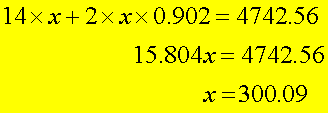
FOURTEEN PAY x rand and TWO PAY …………………
THEREFORE, 15.8x = 4912.80
x =
WHY NOT : 4912.80 divided by 16 etc?

A group of 24 university students decide to go on a weekend outing of two days. Their expenses will be based on a total of 628 kilometres of traveling, and the following:
· R580 daily rental for a 20-seater bus plus R1.75 per kilometre;
· R10.07 per litre of petrol; (Note: Assume 1 litre of petrol covers 9.5 km)
· R275 per day to hire each of the required 4 bungalows.
· R330 daily rental plus R1.25 per kilometer for a double cab.
The students all agree to pay as follows:
· The total expense is divided equally amongst themselves;
· Two drivers chosen from themselves, each pay 5.5% less than their mates;
· Those who withdraw have to pay R100 penalty fee.
Calculate the total amount each one has to pay, if three of them withdraw and decide not to join the weekend outing. (If necessary, use the back of this page for your calculations.)
PLEASE REFER TO APPROPRIATE QUESTION
MINI-BUS PETROL BUNGALOWS 4x4



2×550 2×32×R7.04 4×2×R239 2×300
+ +
1.5×320
1.25×320
TOTAL COST

R1 580 + R450.56 + R1 912 + R1 000
=R4 942.56
TWO DON’T GO

R4 942.56 –R200
16 HAVE TO PAY

LET x be the price 14 pay, then 2 will pay 2×x×0.902
PROBLEM 1
In the recent 2008 Olympic games held in the Bird’s Nest stadium in Beijing, the Jamaican sprinter Usain Bolt ran the 100 metres in 9.69 seconds to clinch the gold medal for this event.
(a) Estimate his average speed over this distance in km per hour.
(b) Express his average speed over this distance in km per hour.
Solution
(a) One has a good idea of 20, 60 and 80 km/hour (stemming from our car driving experiences). Hence as good estimate would be 30-40 km/hr.
(b) Time needed to cover 100 metres = 9.69 seconds
Since 1 km is ten times 100 metres, time taken to complete 1 km = 96.9 seconds = 1.615 minutes
(divide by 60, since 60 secs = 1 minute)
Therefore, the distance covered in 1 hour = 60 divided by 1.615 = 37.15 km
Therefore Bolt’s average speed = 37.15 km/hour
PROBLEM 2
A special type of engine oil treatment is sold for R119 for 350 ml at a particular store. The same store also sells a 500 ml container of the same thing for R149. Which is the better buy?
Partial Solution:
Work out the respective prices per ml for each OR
Work out the respective quantities per rand.
PROBLEM 3
In the World Athletics Championship competition held …….., Germany on Sunday 16 August 2009, the Jamaican sprinter Usain Bolt ran the 100 metres in ……….. seconds to clinch the gold medal for this event.
Determine:
(1) By how many seconds did Bolt improve his previous world record set a year ago? (0.11 secs)
(2) His speed in km/h over the distance. (37.5782881 km/h)
(3) What is the percentage decrease in the time over the distance? (1.135%)
(4) What is the percentage increase in his speed over this distance? (1.15%)
PROBLEM 4
When laying a wooden floor of a room, a workman hammered in nails at an average rate of two nails every 2 minutes and 15 seconds. In total, 550 nails were needed to do the job. If the average time taken to hammer in the nails becomes 0.125 seconds less each time after the first 10 had been hammered in, calculate the total time in hours taken to hammer in ALL the nails?
Solution:
Time to hammer in 10 nails = 2.25 × 5 = 11.25 minutes
Time to hammer in 11th nail = (½ of 2.25×60 – 0.125) secs = 67.375 secs = a
d = 0.125 secs
n = 540
Thus T =
= 
=  secs
secs
= 18191.25 secs
= 5.053125 hours
= 5 hours 3 mins 11.25 secs
T2 W1 L1
PROBLEM 1
A group of 18 students decide to go on a weekend outing of two days. Their expenses will be based on 420 kilometres of traveling for each vehicle hired, and the following:
· R550 daily rental for a 12 seater mini-bus plus R1.50 per kilometre;
· R7.92 per litre of petrol; (Use: 1 litre of petrol covers 10 km)
· R349 per day each to hire 4 bungalows.
· R300 daily rental plus R1.35 per kilometer for a double cab.
The students all agree to pay as follows:
· The total expense is divided equally amongst themselves;
· The drivers who each pay 10 % less than their mates;
· Those who withdraw have to pay R125 penalty fee.
Calculate the total amount each one has to pay, if two of them withdraw and decide not to join the week-end outing.
PROBLEM 2
A taxi-fleet owner of a number of similar 1600 cc four-door sedans, charges the following weekly rates for transport services:
· R10 for every kilometre travelled; and
· R15 basic fee per half an hour of travelling.
· In addition to the above, the charge for waiting is R45 per hour. Over weekends his fee is 15% more than his weekly rate.
(a) Calculate his gross income for a 5-day week, if his fleet carried passengers a total of 2450 kilometres in 500 hours. The total waiting time during that week was 36 hours.
(b) If petrol cost him R7.45 per litre, which allows him to travel 8 km on the average, how much petrol did he use during the week when he covered 2450 kilometres;
(c) How much is his gross income for a weekend during which he conveyed passengers over 1450 km in 240 hours with a waiting time of 24 hours?
(d) If his weekly fleet maintenance bill amounts to R2000, and the wages of the drivers total R 10 000, calculate his loss/profit for the week, using your answers in (a) and (b) above for the owner’s gross income and petrol costs.
PROBLEM 3
For which value(s) of T (the ‘THOUSANDS’ digit) would the total bursary fund allocation of 9T 058.36 rands be exactly and equally divisible amongst eleven students.
PROBLEM 4
A column of liquid in a thermometer is 34.5 mm long at a temperature of 28°, and 40.5 mm long at a temperature of 40°.
(a) How long will the column be at 18°?
(b) At what temperature will the column be 30 mm long?
© DESMOND DESAI, DMD EDU-HOME, 2009
All rights reserved. Designed and created by Desmond Desai, South Africa. This page is protected by Copyright. No part of this page may be reproduced, stored in a retrieval system, or transmitted in any form of by any means, electronic, mechanical, photocopying, recording or otherwise, without the prior written permission of the copyright holder.